Ghana and South Korea Strengthen Development Partnership
Ghana and South Korea are exploring new areas of strategic collaboration aimed at strengthening infrastructure development, improving health systems efficiency and advancing community-level economic growth, as part of efforts to drive sustainable national development.
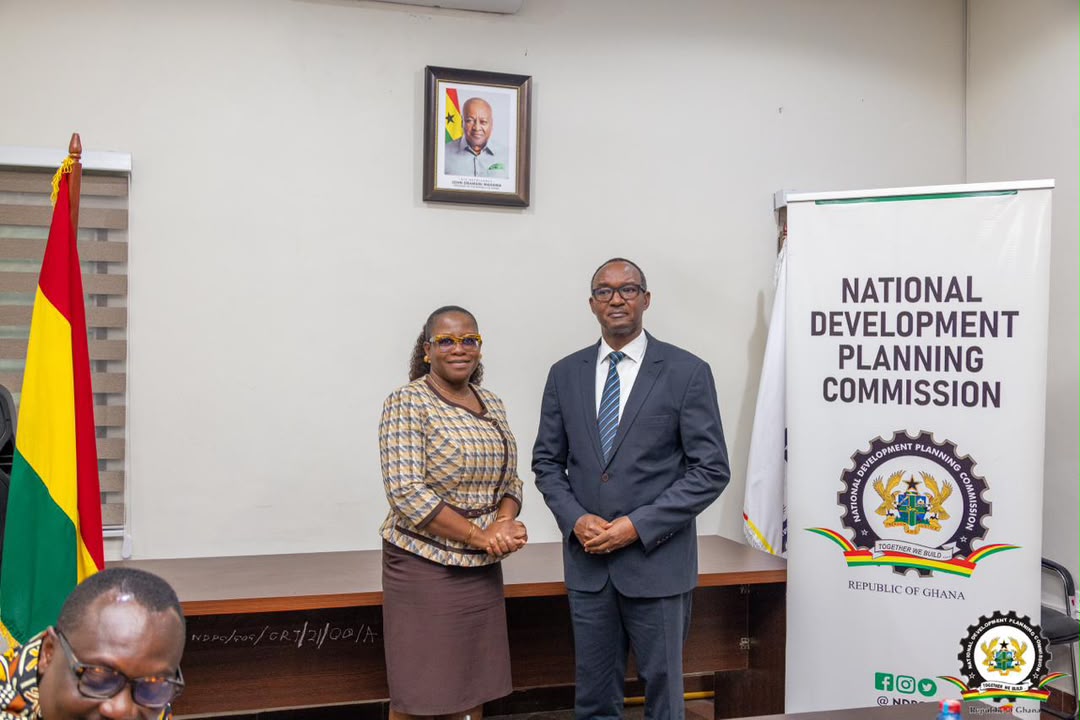
This came to light when Ms. Boyeon Choe, representing the Korea International Cooperation Agency (KOICA), paid a courtesy call on the Chairman of the National Development Planning Commission (NDPC), Dr. Nii Moi Thompson, on Friday, 6 February 2026.
The meeting provided an opportunity for both sides to review ongoing and proposed development interventions, share lessons from past collaborations, and identify new areas for partnership particularly in infrastructure, health systems strengthening and local economic development.
Dr. Thompson described South Korea’s development journey as one from which Ghana could draw valuable lessons, especially in the area of institutional efficiency and applied research.
“South Korea’s experience shows clearly that development is not only about pouring money into projects. It is about strong institutions, efficient systems and deliberate investments in knowledge and infrastructure that support local economic activity,” he said.
A key highlight of the discussions was South Korea’s Railway Research Institute, which Dr. Thompson noted could serve as a valuable partner for Ghana as the country continues to explore rail-based transport solutions to support industrialisation and regional connectivity.
“There is a lot Ghana can learn from Korea’s railway research ecosystem how research informs policy, how infrastructure supports industry, and how transport becomes a catalyst for local development,” he noted, adding that collaboration and knowledge-sharing in this area could be mutually beneficial.
Ms. Choe, in her remarks, emphasised KOICA’s commitment to supporting Ghana’s development priorities, particularly projects that deliver tangible benefits at the community level. She highlighted the success of previous interventions and expressed optimism about scaling up initiatives that demonstrate impact.
“Our experience has shown that when projects are well-designed and grounded in local needs, they can deliver strong results. Where current projects are successful, we are open to exploring a second phase or scaling up infrastructure support,” she said.
She also announced KOICA’s Local Economic Development Project, which focuses on strengthening agribusiness value chains, which is scheduled to commence in 2026. The project aligns with Ghana’s broader agenda of promoting jobs, value addition and inclusive growth at the local level.
Dr. Thompson raised concerns about rising maternal mortality despite increased public spending, describing it as a clear signal that efficiency and systems reform must take precedence over additional funding.
“If we continue to invest more money and still record worse outcomes, then something is fundamentally wrong with the system. Before allocating more resources, we must re-engineer the processes and institutions responsible for delivery,” he stressed.
He cited the Community-based Health Planning and Services (CHPS) programme as a priority area for institutional process re-engineering, recommending a thorough assessment of workflows, coordination and accountability mechanisms before any further financial commitments are made.
“We cannot fix maternal mortality by money alone. We need efficient systems, clear roles and processes that work. Institutional reform must come first,” Dr. Thompson said.
Dr. Thompson concluded by reaffirming Ghana’s commitment to partnerships that prioritise impact, efficiency and sustainability.
“Our goal is simple: partnerships that translate into real improvements in people’s lives. When collaboration is grounded in strong institutions and local development, the results are sustainable,” he said.